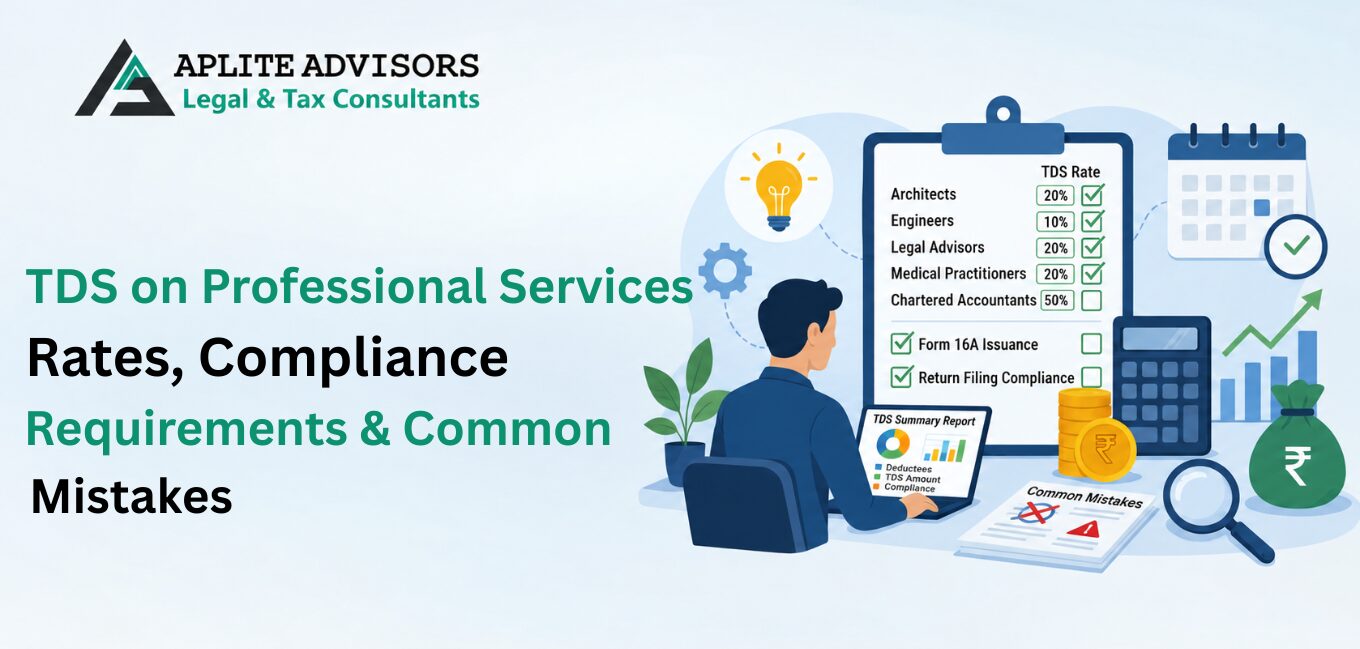
Businesses regularly engage professionals such as chartered accountants, lawyers, consultants, architects, engineers, doctors, and other specialists. Payments made for these services may attract TDS on professional services, making accurate classification, deduction, deposit, reporting, and reconciliation an important part of tax compliance.
For businesses, TDS compliance is not simply about deducting a percentage from an invoice. The payer needs to determine whether the payment falls under professional services, technical services, contract work, commission, or another category, identify the applicable provision and rate, check the threshold, verify PAN and payee details, and complete the required reporting within the applicable timelines.
There is an additional consideration for businesses in 2026: India’s TDS framework has moved to the Income Tax Act, 2025 for sums paid or credited on or after 1 April 2026. The Income Tax Department states that the earlier TDS provisions have been consolidated under Sections 392 and 393, with Section 393 covering specified non-salary payments.
The rates and thresholds are largely retained, but businesses need to update their systems and references because transactions governed by the new Act should use the relevant Section 393 table item rather than old section numbers such as Section 194J.
This guide explains the TDS rate on professional services, applicable thresholds, calculation, compliance requirements, common mistakes, and key changes businesses should understand in 2026.
What Is TDS on Professional Services?
Tax Deducted at Source, or TDS, is a mechanism through which tax is collected at the time certain payments are made or credited.
When a business makes a payment covered by the applicable TDS provisions, it may be required to deduct tax from the payment and deposit that tax with the government.
Professional services can include services such as:
- Legal services
- Medical services
- Accountancy
- Architectural services
- Engineering services
- Technical consultancy
- Interior decoration
- Advertising
- Other notified professional services
The exact classification should be determined based on the nature of the service and the applicable provisions.
Under the Income Tax Act, 2025, fees for professional services are covered within the relevant provisions of Section 393(1), Table Sl. No. 6(iii). The Income Tax Department’s current section text specifies a 10% rate for professional services, while fees for technical services that are not professional services are subject to 2%, subject to the applicable conditions and thresholds.
Who Is Generally Responsible for Deducting TDS?
TDS obligations depend on the nature of the payment and the status of the payer.
For professional-service payments covered by the relevant provision, the payer must determine whether it falls within the category of a person required to deduct tax.
The rules can differ for individuals and HUFs depending on their circumstances, including whether they are otherwise required to deduct TDS and whether specific provisions apply.
Therefore, businesses should not determine TDS applicability solely from the name of the invoice. The payer’s status and the nature and value of the payment also matter.
TDS Rates on Professional Services
For Tax Year 2026–27, the relevant professional and technical service provisions under Section 393 provide the following broad rates:
| Nature of Payment | Applicable TDS Rate | Threshold |
| Professional services | 10% | ₹50,000 per year |
| Technical services, where covered separately | 2% | ₹50,000 per year |
| Certain specified payments | As applicable | Depends on the provision |
The Income Tax Department’s Section 393 provision specifies 2% for fees for technical services that are not professional services and 10% for other specified payments in the relevant category, including professional services. The threshold for the professional and technical service categories is ₹50,000, while director remuneration under the relevant category has no threshold.
Professional Services – 10%
Professional fees generally attract TDS at 10% where the relevant Section 393 provision applies.
Examples can include payments for:
- Legal services
- Accountancy
- Architecture
- Engineering
- Medical services
- Professional consultancy
- Other services falling within the statutory definition
Technical Services – 2%
Fees for technical services that are not professional services are subject to 2% under the relevant Section 393 provision.
This distinction is important because incorrectly classifying a payment can result in TDS being deducted at the wrong rate.
Important: The actual applicability of TDS depends on the specific facts, payer status, payee status, nature of service, threshold, PAN availability, and other applicable provisions. Businesses should verify the relevant law before applying a rate.
When Is TDS Applicable on Professional Fees?
Determining whether TDS applies requires more than looking at the invoice amount.
Businesses should consider several factors.
Nature of the Payment
First, determine what the payment is actually for.
A payment described as “consultancy” may need further analysis because consultancy can fall within different tax categories depending on the nature of the service.
The business should distinguish between:
- Professional services
- Technical services
- Contract services
- Commission
- Royalty
- Other specified payments
Status of the Payer
The payer’s legal and tax status can affect TDS applicability.
For example, the rules applicable to a company may differ from those applicable to an individual or HUF that is not otherwise required to deduct TDS.
Status of the Recipient
Businesses should also verify whether the recipient is:
- Resident
- Non-resident
- Individual
- Firm or LLP
- Company
- Other entity
Payments to non-residents require separate consideration because different withholding provisions and tax treaty considerations may apply.
Applicable Threshold
For professional services covered under the relevant Section 393 provision, the threshold is ₹50,000 during the tax year.
Businesses should monitor the cumulative amount payable to the relevant payee instead of examining every invoice in isolation.
Credit or Payment
The timing of TDS also matters.
The Income Tax Department has clarified that, during the 2026 transition, the governing Act depends on when the earlier event of credit or payment occurs. If the earlier event occurred on or before 31 March 2026, the Income Tax Act, 1961 applies; if it occurs on or after 1 April 2026, the corresponding provisions of the Income Tax Act, 2025 apply.
TDS Threshold for Professional Services
For professional services covered by the relevant Section 393 provision, the monetary threshold is ₹50,000.
This means businesses should monitor the aggregate amount payable to a professional during the relevant tax year rather than assuming that TDS is determined independently for every invoice.
Practical Example
Suppose a company engages a professional consultant and receives the following invoices:
- April: ₹20,000
- July: ₹15,000
- October: ₹25,000
The aggregate professional fee becomes ₹60,000.
Because the cumulative amount crosses the applicable ₹50,000 threshold, the business needs to assess the TDS obligation under the applicable provision rather than treating each invoice as an isolated transaction.
The exact point of deduction and amount subject to TDS should be determined based on the applicable statutory rules and the circumstances of the payment.
How to Calculate TDS on Professional Fees
A simple example can help illustrate the calculation.
Suppose:
Professional fee: ₹1,00,000
Applicable TDS rate: 10%
Calculation
TDS = ₹1,00,000 × 10% = ₹10,000
Therefore:
Gross professional fee: ₹1,00,000
TDS deducted: ₹10,000
Net amount paid to professional: ₹90,000
This is a simplified example. Actual TDS calculations may differ depending on the nature of payment, applicable threshold, PAN availability, statutory provisions, certificates, and other circumstances.
TDS Compliance Requirements for Businesses
Correct deduction is only one part of TDS compliance.
Businesses also need to complete the related payment, reporting, certification, and reconciliation requirements.
1. Identify the Correct TDS Provision
Start by determining the nature of the payment.
Ask:
- Is this a professional fee?
- Is it technical service?
- Is it contract work?
- Is it commission?
- Is it royalty?
- Is another TDS provision applicable?
Correct classification is particularly important because professional and technical services can have different rates.
2. Verify PAN and Payee Details
Before processing payments, businesses should maintain accurate records of:
- PAN
- Legal name
- Address
- Entity type
- Bank details
- Nature of services
- Applicable TDS category
Incorrect PAN or payee information can create reporting and reconciliation problems.
3. Deduct TDS at the Correct Rate
Once the applicable provision and threshold have been established, calculate and deduct TDS at the appropriate rate.
Businesses should also check whether any higher-rate provision applies where PAN or other required information is unavailable.
4. Deposit TDS Within the Applicable Due Date
The tax deducted must be deposited with the government within the applicable statutory timeline.
Late payment can result in interest and other consequences.
Businesses should therefore establish an internal compliance calendar rather than relying on manual follow-up for every transaction.
5. File TDS Returns
TDS deductions must be correctly reported through the applicable TDS filing process.
The return should accurately reflect:
- Deductor information
- Deductee PAN
- Payment amount
- TDS amount
- Date of deduction
- Applicable section/code
- Other required transaction details
The Income Tax Department has introduced revised processes and forms under the Income Tax Act, 2025. Businesses should ensure that their accounting and compliance systems use the appropriate new provisions and reporting requirements.
6. Issue TDS Certificates
TDS certificates provide recipients with evidence of the tax deducted from their payments.
Recipients can use the reported TDS information when determining their tax credit.
7. Reconcile TDS Records
Regular reconciliation can help identify:
- Missing deductions
- Incorrect PAN
- Wrong amounts
- Duplicate entries
- Incorrect section codes
- Unmatched challans
- Reporting discrepancies
The Income Tax Department’s systems allow taxpayers to view TDS-related information, and TDS credit is relevant to the recipient’s tax records.
Common Mistakes in TDS on Professional Services
TDS errors are often caused by classification and process issues rather than calculation alone.
Here are some common mistakes businesses should watch for.
1. Applying the Wrong TDS Section
One of the most common mistakes is using the wrong provision because the service has been classified incorrectly.
For example, professional services and technical services can attract different rates.
2. Using the Wrong Rate
A business may deduct 2% where 10% applies or vice versa.
The correct rate should be determined based on the actual nature of the service and the relevant provision.
3. Missing the Threshold
Businesses sometimes evaluate invoices independently and fail to monitor cumulative payments to a professional.
Maintaining a vendor-wise TDS tracker can help prevent this problem.
4. Not Checking PAN
Incorrect or missing PAN information can result in higher withholding requirements or reporting issues.
PAN should therefore be verified before processing payments.
5. Delaying TDS Deposit
Deducting TDS but depositing it late can result in interest and other compliance consequences.
A fixed monthly compliance process can reduce the risk.
6. Incorrect TDS Return Details
Even when the tax amount is correct, incorrect PAN, payment amounts, dates, or section codes can cause mismatches.
7. Confusing Professional and Technical Services
This is particularly important because the applicable rates differ.
A business should not decide the category solely based on words such as “consultancy” or “technical” appearing on an invoice.
The actual nature of the service should be examined.
8. Failing to Reconcile Records
Businesses should periodically reconcile their books, TDS returns, challans, and available tax records.
9. Continuing to Use Outdated Section References
This is especially relevant in 2026.
For transactions governed by the Income Tax Act, 2025, businesses should not simply continue using old references such as Section 194J.
The Income Tax Department has specifically stated that for transactions on or after 1 April 2026, the relevant Section 393 table item should be quoted. Using old section numbers such as 194J can result in system-level validation errors.
10. Ignoring Non-Resident Payment Rules
Professional or consultancy payments to non-residents require separate analysis.
Businesses should not automatically apply the resident professional-fee rate without considering the applicable provisions, tax treaty, residential status, and other requirements.
TDS on Professional Fees Under the Income Tax Act, 2025
One of the most important developments for businesses in 2026 is the transition to the new Income Tax Act, 2025.
The new framework applies to relevant sums paid or credited on or after 1 April 2026.
The Income Tax Department explains that the earlier TDS provisions from Sections 192 to 194T of the Income Tax Act, 1961 have been consolidated primarily into:
- Section 392 – TDS relating to salaries
- Section 393 – TDS relating to other specified payments
Section 393 uses tables to organize TDS provisions based on categories of payments and payees.
What Happened to Section 194J?
Section 194J was the familiar provision used under the Income Tax Act, 1961 for several professional and technical service payments.
For transactions governed by the Income Tax Act, 2025, the corresponding provision is now found within Section 393(1), Table Sl. No. 6(iii).
For professional services, the relevant category carries a 10% TDS rate with a ₹50,000 threshold. Fees for technical services that are not professional services are covered separately at 2%, with a ₹50,000 threshold.
Why Does the Change Matter?
The change is not merely about renumbering.
Businesses need to update:
- Accounting software
- TDS master data
- ERP systems
- Vendor records
- Compliance checklists
- TDS return processes
- Internal tax documentation
The Income Tax Department has specifically advised deductors to use the relevant new Section 393 table item for transactions governed by the new Act.
TDS on Professional Services for Individuals, Firms and Companies
TDS applicability can differ depending on who is making the payment.
Companies
Companies making payments for professional services generally need to examine the applicable TDS provisions and deduct tax where the requirements are satisfied.
Firms and LLPs
Firms and LLPs should similarly evaluate their professional-service payments against the relevant TDS provisions.
Individuals and HUFs
Not every individual or HUF automatically has the same TDS obligations as a company.
Specific provisions can apply to individuals and HUFs based on their business or professional status, turnover, and other conditions.
For example, the Income Tax Department’s 2026 material separately addresses certain payments by individuals or HUFs who are not otherwise required to deduct TDS under other provisions.
Therefore, businesses and professionals should evaluate their own status before concluding that TDS is or is not applicable.
TDS on Professional Services: A Practical Compliance Checklist
Businesses can use the following checklist when processing professional-service payments:
- Identify the exact nature of the service
- Determine whether it is professional or technical service
- Check payer eligibility and status
- Verify recipient residential status
- Verify PAN
- Check the applicable threshold
- Track cumulative payments to the payee
- Identify the correct TDS provision
- Apply the correct TDS rate
- Deduct tax at the appropriate time
- Deposit TDS within the applicable due date
- File the applicable TDS return
- Issue the required TDS certificate
- Reconcile books and TDS records
- Use the correct 2026 Section 393 reference where applicable
A standardized checklist can significantly reduce avoidable TDS errors.
How Aplite Advisors Can Help With TDS Compliance
TDS compliance can become difficult when a business makes payments to multiple professionals, consultants, vendors, contractors, and service providers.
Aplite Advisors can assist businesses with tax and compliance processes related to professional payments and TDS requirements.
Support can include:
TDS Calculation and Deduction
Businesses can receive assistance in determining applicable TDS requirements and calculating deductions based on the nature of the payment.
TDS Return Filing
Accurate TDS reporting is essential for maintaining proper compliance records and minimizing mismatches.
Compliance Review
A review of existing TDS processes can help identify issues involving:
- Incorrect classifications
- Wrong rates
- Missing deductions
- Threshold errors
- Reporting discrepancies
- Reconciliation issues
TDS Reconciliation
Regular reconciliation can help businesses identify differences between accounting records, TDS returns, challans, and available tax information.
Tax Advisory
Professional tax guidance can help businesses understand how changes in tax provisions affect their payment and compliance processes.
Assistance With Compliance Issues
Where businesses encounter TDS-related notices, mismatches, or other compliance concerns, professional assistance can help them assess the issue and determine an appropriate response.
For businesses operating under the 2026 tax framework, keeping TDS processes updated is particularly important because old section references should not simply be carried forward into new transactions.
Conclusion
TDS on professional services is an important compliance responsibility for businesses that regularly engage consultants, lawyers, accountants, architects, engineers, and other professionals.
Correct compliance requires more than applying a percentage to an invoice.
Businesses need to:
Classify the payment correctly → Check the threshold → Identify the applicable provision → Deduct at the correct rate → Deposit on time → Report accurately → Reconcile regularly.
The 2026 transition to the Income Tax Act, 2025 makes this even more important. Although the Income Tax Department states that TDS rates and thresholds are largely retained, businesses need to update their processes and use the appropriate Section 393 references for transactions governed by the new Act.
For professional services, the current framework generally provides for a 10% TDS rate with a ₹50,000 threshold, while qualifying technical services that are not professional services are generally subject to 2%, subject to the applicable provisions.
For businesses, maintaining accurate records, reviewing vendor classifications, monitoring thresholds, and reconciling TDS regularly can help reduce avoidable compliance problems.
Aplite Advisors can help businesses manage TDS calculations, compliance reviews, return filing, reconciliation, and tax-related advisory requirements.
Need help reviewing your TDS compliance under the 2026 tax framework? Connect with Aplite Advisors for professional tax and compliance support.
Frequently Asked Questions
TDS on professional services is the withholding of tax from certain payments made for professional services when the applicable tax provisions require the payer to deduct tax.
For professional services covered under the relevant Section 393 provision of the Income Tax Act, 2025, the applicable rate is generally 10%, subject to the applicable conditions. The threshold for this category is ₹50,000.
The timing depends on the applicable TDS provision and the relevant event of payment or credit. During the 2026 transition, the Income Tax Department has clarified that the governing Act depends on the earlier event of credit or payment.
For professional services under the relevant Section 393 category, the threshold is ₹50,000 during the applicable tax year.
It can be. The classification depends on the actual nature of the consultancy service and the applicable statutory provision. Professional consultancy and technical services can fall under different categories and rates.
Under the current Section 393 framework, professional services generally attract 10%, while fees for technical services that are not professional services are subject to 2%, subject to the applicable conditions and threshold.
Incorrect TDS deduction can create compliance issues, including short deduction, interest, reporting discrepancies, and potential tax consequences. The appropriate corrective action depends on the circumstances.
Common mistakes include incorrect classification, wrong rates, missing thresholds, incorrect PAN details, delayed deposits, inaccurate returns, failure to reconcile records, and continued use of outdated section references.
For sums paid or credited on or after 1 April 2026, the Income Tax Act, 2025 governs the applicable TDS provisions. The earlier TDS provisions have been consolidated primarily under Sections 392 and 393. For applicable non-salary payments, businesses need to use the relevant Section 393 table item rather than old section references such as 194J.
Yes. A tax professional can help businesses assess TDS applicability, classify payments, calculate deductions, review compliance processes, file returns, reconcile records, and address applicable TDS-related issues.